Tesla Develops Internal Map System to Fix FSD Navigation Errors
The automaker is leveraging fleet data to create proprietary maps that address recurring issues with speed limits and parking for its Full Self-Driving software.
By Rahul Sato ·
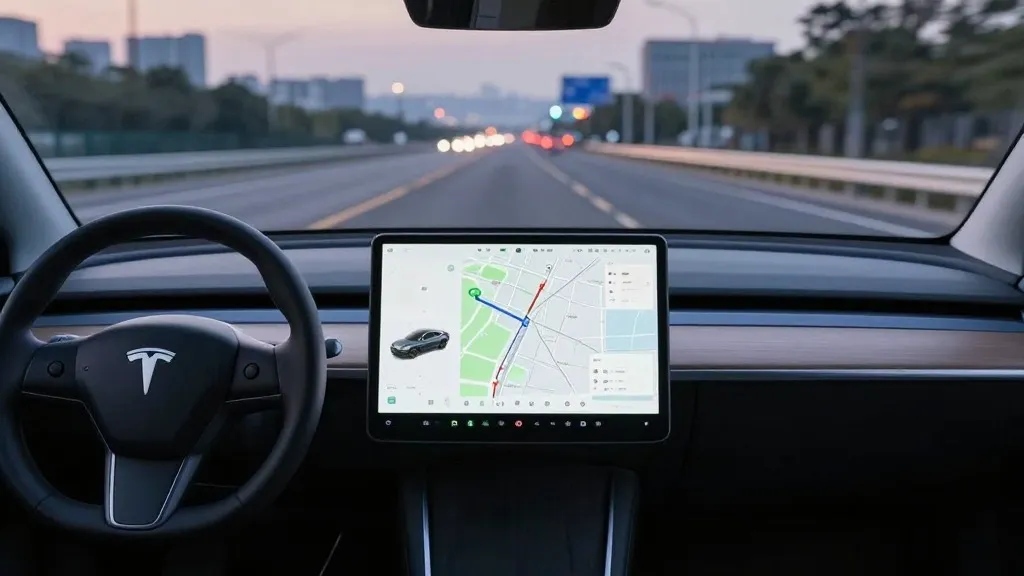
55 percent. That is the rate at which Tesla vehicles were found speeding in 30 km/h zones in Brussels, a statistic that highlights a persistent flaw in the company's Full Self-Driving system. To correct these and other navigation errors, Tesla announced on its Q3 2026 earnings call that it is developing its own internal maps. This move marks a significant strategic shift for a company that previously argued against the need for detailed cartographic data in autonomous driving.
The decision follows direct feedback from shareholders during a Q&A session. A retail investor noted that mapping remains a core issue, specifically citing difficulties with reading speed limits, handling parking, and selecting typical routes. Ashok Elluswamy, Tesla’s VP of AI, agreed that the company should not rely on external providers. He explained that the new system uses an AI-based architecture fed by data collected from the vehicle fleet. This infrastructure will also learn individual driver preferences and respond to voice commands.
The rollout is planned to begin with FSD v15, initially managing the start and end of trips. Over the coming months, the system will expand to handle broader navigation, parking, and destination selection. This approach contrasts with Tesla’s earlier stance. In 2019, CEO Elon Musk dismissed high-precision lane maps as a mistake that made systems brittle. He famously called lidar a fool's errand, suggesting that cameras and AI alone could solve driving problems anywhere. Now, seven years later, the company is building a map layer from its own fleet to address the gaps in its vision system.
This development brings Tesla closer to the methodology used by Waymo. While Tesla’s maps are not the centimeter-level HD maps Musk once criticized, the core concept is similar. Waymo uses sensor-equipped vehicles to map cities before launching service and keeps those maps updated. Tesla is now describing a process where cars collect visual data that feeds a central map, helping every vehicle drive better. The primary hardware difference remains that Waymo’s cars are equipped with lidar, whereas Tesla relies on cameras.
The need for this map layer is underscored by recent safety findings. In the United States, the NHTSA is considering an investigation into claims that Tesla Robotaxis speed through active school zones. This involves roughly 1,000 Model Y and Cybercab vehicles. A speed limit sign is a basic piece of road information, and if a vision system frequently misreads it, the addition of a map suggests that vision alone is not yet sufficient. This aligns with Tesla’s current Robotaxi operations, which function within specific geofenced areas rather than across open roads.
Tesla’s unsupervised FSD for consumer cars is currently targeted for Q2 of 2027. Until then, the company continues to refine its technology. By building its own maps, Tesla is acknowledging that understanding the environment requires more than just real-time camera input. The fleet will serve as a collective learning tool, providing the data necessary to fix the specific errors that have plagued the system for years.
Source: Electrek · original report published