
1969: The Year Humanity Touched the Moon
A new episode of Star Gazers revisits the historic Apollo 11 landing, contrasting it with current plans to return to the lunar surface.
By Rahul Sato ·
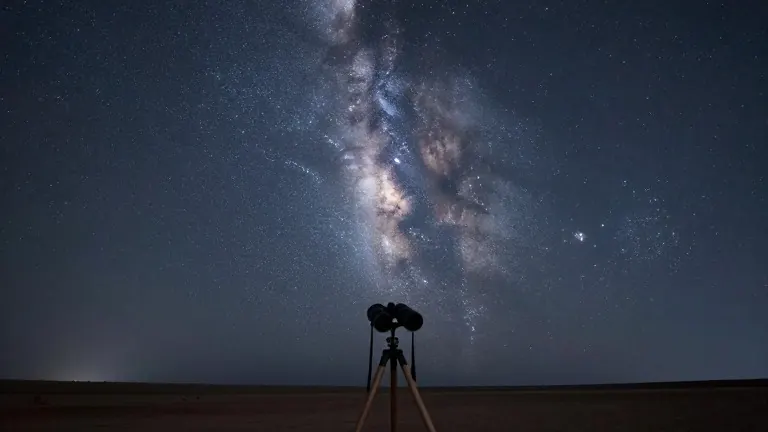
Space enthusiasts are turning their attention back to the moon. The recent broadcast of the Star Gazers series features a retrospective on the Apollo 11 mission. The episode asks what happens when a human falls into a black hole, but it also looks at the concrete history of lunar exploration. It centers on the events of July 20, 1969.
On that date, humanity achieved a feat that seemed impossible just years prior. The Apollo 11 crew landed on the moon. The source material describes this achievement as the unthinkable. It stands as a fixed point in the timeline of space travel. The broadcast uses this historical anchor to frame current astronomical discussions.
Host Trace Dominguez guides viewers through a thought experiment. He moves from the historical landing to a moonless world. This segment explores the physics of falling into a black hole. It serves as a bridge between past achievements and current theoretical questions. The host uses plain language to explain complex astrophysical concepts.
The program also highlights the Nancy Grace Roman Space Telescope. Dominguez introduces this upcoming NASA mission. The telescope represents the next step in observational astronomy. It follows the legacy of the Hubble Space Telescope. The source notes that spacecraft use planets to pick up speed. This technique, known as a gravity assist, is essential for deep space missions.
The episode includes a segment on the Perseids meteor shower. This event is described as one of the most dazzling of the year. Viewers are reminded of the current state of the International Space Station. The ISS is scheduled for deorbit in 2030. This timeline marks the end of an era for the current station.
The broadcast touches on the activity of the sun. The star is getting busy, which is good news for sky watchers. Solar activity affects radio waves and light in the visible spectrum. Scientists recently discovered intense radio noise from deep space. This finding adds to the data collected by missions like Juno.
Juno has provided new views of Jupiter. The mission continues to send back images that were previously unseen. The source emphasizes the engineering behind NASA's largest telescope. Dominguez breaks down the five different types of nebulae. He explains that shooting stars are not stars. They are meteors burning up in the atmosphere.
The program offers practical advice for beginners. Dominguez provides five tips for those ready to start stargazing. He points out that autumn is a good time to see the northern lights. The aurora borealis is a natural light display. The moon also experiences weather, a fact that surprises many observers.
The episode covers specific celestial events. It mentions a lunar eclipse scheduled for a future date. It also references a solar eclipse. Viewers are told to look for Venus and Cassiopeia before dawn. The Big Dipper is used as a guide to find two specific stars. Mars will get super close to Earth in the coming months.
The final segment discusses the movement of planets in the evening and morning sky. It notes that Venus will reign supreme in the heavens. The program concludes with a reminder to use the moon to find planets. The source lists a series of dates from 2014 to 2026. These dates mark the release of the 5-minute Star Gazers episodes. The most recent content aligns with the current broadcast schedule.
Source: Cascade PBS