
NASA Prepares New Telescope to Hunt for Distant Worlds
The Nancy Grace Roman Space Telescope will survey a vast area of the sky to find exoplanets and study dark energy.
By Adam Lin ·
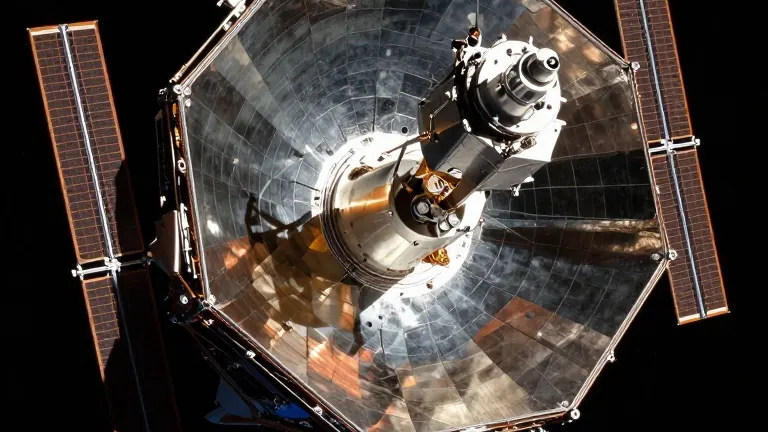
NASA is moving forward with plans for the Nancy Grace Roman Space Telescope, a major upgrade to the agency’s capabilities for observing the universe. The new observatory is designed to look at a much wider slice of the sky than its predecessors, allowing scientists to gather data on a scale not previously possible from a single instrument. This shift in strategy changes how researchers will catalog distant planets and measure the expansion of the universe, providing a new tool for public understanding of cosmic history.
The telescope is named after Nancy Grace Roman, an astronomer who helped establish the modern era of space-based astronomy. Her work laid the foundation for the Hubble Space Telescope, and the Roman mission is intended to build on that legacy. The primary goal is to detect exoplanets, which are worlds orbiting stars other than the Sun, by using a technique that looks for the dimming of starlight as a planet passes in front of it. This method allows for the rapid identification of thousands of potential worlds in a single survey.
In addition to hunting for planets, the Roman Space Telescope will help scientists understand dark energy. This invisible force is believed to be accelerating the expansion of the universe. By measuring the shapes of distant galaxies, the telescope will provide precise data on how the universe has stretched over time. These measurements will help researchers test competing theories about the nature of dark energy and the long-term fate of the cosmos.
The mission will also observe Trojan asteroids, which are rocks that share orbits with planets. These objects are thought to be leftovers from the early solar system. By studying their composition and distribution, astronomers hope to gain insights into the conditions that existed when our solar system formed billions of years ago. This data may reveal how the inner planets migrated to their current positions.
The Roman Space Telescope is expected to cover 200 times the area of the sky in a single observation compared to the Hubble Space Telescope. This wide field of view is central to its mission. It allows the telescope to take a comprehensive census of the universe, capturing millions of galaxies and stars in one exposure. The instrument is designed to operate in the infrared part of the spectrum, which allows it to see through dust clouds and detect faint, distant objects that are invisible to optical telescopes.
The development of the Roman Space Telescope represents a major investment in astronomical infrastructure. It is intended to work alongside other observatories, including the James Webb Space Telescope, to provide a more complete picture of the universe. While Hubble focuses on deep, detailed views of specific targets, Roman is built for wide-area surveys. This complementary approach ensures that scientists can both zoom in on specific objects and map the large-scale structure of the cosmos.
Source: Cascade PBS