Forest Survey: Student research aims to guide state timber decisions
A Western Washington University graduate student is measuring 44 forest plots in Whatcom County to help the Department of Natural Resources determine which stands should be logged and which should be conserved.
By Idris Robinson ·
State forest managers face a growing decision on how to handle timber sales in Whatcom County. A new survey by a Western Washington University student is providing data to help the Department of Natural Resources distinguish between forests that are ready for harvest and those that should be preserved.
Finley Bell, a second-year graduate student in environmental studies, is leading the project. He is surveying 44 forest plots on DNR land that are scheduled for timber sales within the next decade. The goal is to identify which stands are most suitable for logging and which should be prioritized for conservation.
The DNR manages 2.1 million acres of working forests in Washington. The agency is legally required to manage this land for timber harvesting, but it is also working to balance that revenue with ecological health. In 2025, the DNR launched a plan to identify over 77,000 acres of structurally complex forests. That target was adjusted down to 55,000 acres in September 2026. The plan aims to ensure that 10 to 15 percent of state forests reach mature or old-growth status within 70 to 100 years.
Bell uses DNR LiDAR data and satellite imagery to pinpoint areas likely to contain mature forests. He then verifies this data on the ground. His team measures the circumference and height of standing trees and snags, notes species distribution, and extracts pencil-sized cores from the largest trees to analyze age in the university’s dendrochronology lab.
The research is being conducted as the DNR updates its management plans. Aquila Flower, director of the Western Spatial Institute and Bell’s faculty advisor, stated that the DNR is actively creating new forest management and conservation plans. She noted that while the agency has collected recent data, uncertainty remains regarding the location of structurally complex forests.
Bell calculated that Whatcom County contains more than 116,000 acres of DNR-managed land. Many of the county’s legacy forests were selectively logged between the late 1800s and the mid-1900s. Because these forests were not replanted after logging, they have regenerated naturally and regained much of their original biodiversity.
Bell distinguishes these legacy forests from stands that are better suited for timber. He describes the timber-suitable plots as previously logged and replanted on a 40 to 60 year cycle. These stands are densely and uniformly planted, mostly with fast-growing Douglas fir and grand fir. Bell noted that these forests often have little undergrowth, with the forest floor sometimes appearing as bare dirt.
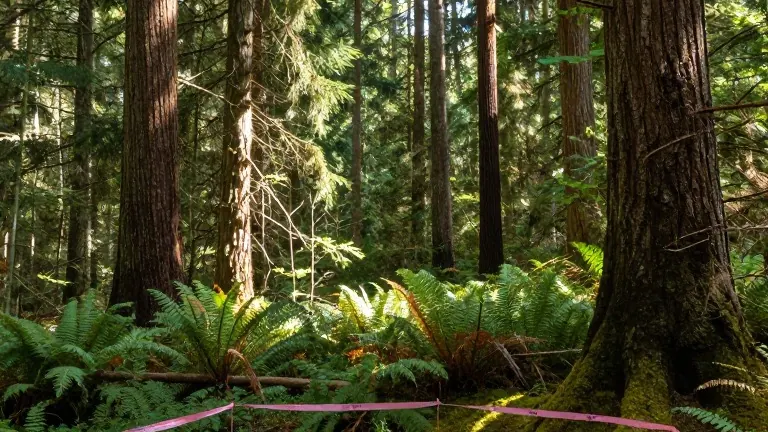
In contrast, the legacy forests Bell is surveying feature a multi-layered canopy, diverse species, and dense undergrowth. He identified one plot in Olsen Creek State Forest as approaching the characteristics of an old-growth forest. The area contains large dead and downed trees, which Bell said is a strong indicator of forest complexity.
Bell acknowledged that DNR timber sales help fund K-12 schools and other state services. He said his research will recommend that certain forests be logged because they are not structurally complex. However, he argued that forests like the one in Olsen Creek should be conserved to allow them to reach old-growth status.
Bell has spent recent summers as a wildland firefighter in eastern Oregon. He said that forest management impacts wildfire risk. He noted that without undergrowth, there is less fuel for fires to spread. His findings will be made available to the DNR, nonprofits, and the public.
Source: Salish Current