Leonid Meteor Shower Peaks in November Without Lunar Interference
Astronomers in the D.C. region advise residents to clear their eastern horizons for a series of planetary alignments and a full supermoon later this month.
By Idris Robinson ·
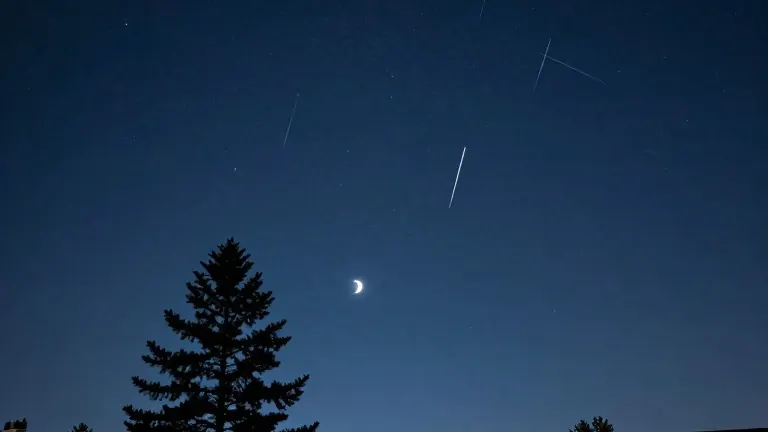
Stargazers across the region have a packed calendar for the current month, with clear skies expected for several key celestial events. The most anticipated event is the peak of the Leonid meteor shower, which occurs on the nights of November 16 and 17. This year, the meteor shower will not be hindered by moonlight, offering optimal conditions for viewing.
The month begins with the end of daylight saving time on November 1, when clocks turn back at 2 a.m. for most of the United States and Canada. Shortly after, on November 2, a waning crescent moon will appear in the eastern sky before dawn. It will form a line 13 degrees long with bright Jupiter, reddish Mars, and the star Regulus. Observers can capture this alignment using a smartphone with zoom capabilities or a digital camera.
The variable star Algol provides multiple viewing opportunities throughout the month. It reaches its minimum brightness for a period of two hours centered at 1:45 a.m. EST on November 4. Additional dimming events are scheduled for 10:45 p.m. EST on November 6, 7:23 p.m. EST on November 9, 12:17 a.m. EST on November 27, and 9:06 p.m. EST on November 29.
Venus and the star Spica will be visible together in the eastern horizon at 5:30 a.m. EST on November 7. On that date, an almost new moon will also be present in the sky. By November 10, Venus and Spica will move into a very close proximity, requiring a clear view of the eastern horizon for best observation. Mars and Jupiter will remain in close company in the eastern sky throughout the night on November 16.
The Full Beaver Supermoon is set to rise at sunset on November 23 and 24, providing prime conditions for photography. The full moon phase occurs at 9:53 a.m. EST on November 24. On November 30, the gibbous moon will join Jupiter, Mars, and Regulus high in the eastern sky around 5 a.m. EST. Venus and Spica will also be visible near the eastern horizon at that time.
Local astronomy groups are hosting various programs for the public. Shenandoah National Park offers presentations through its "Let's Talk About Space" series, with rangers also hosting night sky programs. Virginia State Parks and George Mason University's NOVAC group are scheduling additional events. The Analemma Society has resumed observatory operations, offering Friday night public viewing sessions at Turner Farm in Great Falls, Virginia.
The Smithsonian National Air and Space Museum in Washington, D.C., and its facility in Chantilly, Virginia, feature astronomy exhibits this month. A new attraction titled Smithsonian Starstruck: An Immersive Experience is currently open at the D.C. location. Residents interested in events outside the capital can check the calendars of the Night Sky Network and the Astronomical League.
Source: WTOP News